Posts

Madrid – a city of great blessings!

 
These are some shots of Madrid – there are signs all over for World Youth Day.   There is also a shot of Americans gathering for a special Mass with the U.S. bishops today.   Our seminarians had a special mass with the Pope this morning.

For those of you who are joined to us spiritually by prayer since when we first left Krakow – a little update:  We made it to Madrid after a wonderful day of prayer at Manresa – where St. Ignatius spent a year in prayer and spiritual trials.   We soon began to experience our own trials.  Our bus broke down outside of Zaragoza and we got here late on Thursday.  But in a way World Youth Day began at the truck stop in Zaragoza.  The seminarians pulled out a guitar and started to sing.  Soon whole groups of pilgrims began to join us.   It was wonderful fellowship.  One lady was so moved she gave another guitar as a gift – so we sang a special song for her and prayed together.  The joy and excitement in Madrid are very beautiful — like that moment at the bus stop.  The Spanish are wonderful hosts.  

It is hard to explain the graces that are here.   Nothing has been real easy – yet everything filled with so much joy.  Trials and sacrifices and hardships are the greatest blessings on a pilgrimage.  At the time you do not see it – but then if you are patient and trust – God does some great and unexpected thing.   Isn’t this just the way He works in our lives all the time when we let Him?  Thanks for praying for us and for all your support for our future priests.   God is raising up some remarkable men to serve the Church – 

Montserrat and St. Ignatius


We had mass at the Benedictine Monastery at Montserrat up above Barcelona today and tomorrow we will go to Manresa.  What ties these two places together is St. Ignatius of Loyola.  Montserrat has a miraculous image of Our Lady – said to be associated with St. Luke.  It is believed that this image was discovered by shepherds in 880 A.D. although some historians believe it was actually carved in the 12th Century.  Whatever the actual history, there have been various shrines on top of this mountain where Christians have dedicated their lives to prayer for over a millennium.  Benedictines eventually founded a monastery there in the 11th Century.


St. Ignatius came here after his initial conversion.  Wounded by a canon ball during a battle and while recovering at his brother’s house he discovered the presence of the Risen Lord in his life.  He noticed this presence through reading.  When he read novels about chivalry and romance, he reflected on how these entertained him while he was reading but afterwards left him empty.  When he read the lives of the saints, he discovered that his heart burned within and stirred with desires to imitate their zeal for the Lord.  Recognizing the opposition of these two movements of the spirit helped him see Christ as the one who could help him live life to the full.  Indeed, we only discover the gift of who we really are through an authentic gift of ourselves to others, and Christ alone makes givings ourselves in this way a real possibility. Ignatius wanted this possibility in his life and he resolved to follow Christ.  With this resolution, he went to Montserrat and spent two days making a confession of all his sins.  After his confession, he spent the night in prayer – as a knight in arms – before Our Lady of Montserrat.  At the end of his prayer, he left his sword with our Lady and decided to spend the rest of his life as a pilgrim doing penance.  This would eventually lead him to Manresa.  Here he spent a year in solitude – fasting, praying and doing penance.  He battled severe bouts with depression and all kinds of spiritual trials.  In the end, he had a deep encounter with the Holy Trinity, gained wisdom of heart and wrote down his insights in what we now know as the Spiritual Exercises of St. Ignatius.  


This was an important day for our seminarians.  Before their formal studies, all of them go through a year of spiritual formation which seeks to tap the wisdom of heart St. Ignatius learned at Manresa.  While I do not think they have visions of the Trinity as did the founder of the Society of Jesus, many of them experience graces that are life changing in all kinds of different ways.  It is the wisdom of heart that one gains through being generous with God in prayer and with one’s life that most prepares them for the work God has for them.  Please keep them in prayer that we might gain this wisdom- tomorrow to Madrid!

We are in Spain!

After a plunge into the ocean Today we made it to Barcelona.  Our pilgrimage takes us to the Cathedral and Montserrat tomorrow – and if things go well possibly Manresa.  
Some of our experiences — it is live music on the gandola — in Venice: Day 5
And then what we saw in Milan: Day 6

Pilgrimage – visible travel and spiritual journey

Pilgrimage has an arduous physical dimension but the prayer with which it should be imbued is even more demanding.  The great teachers on prayer remind us that prayer is not something that naturally comes to us.   It is a gift from God which one must ask for and it requires great effort and determination.  It is a pilgrimage of faith.  Just as a great journey is normally embarked upon after acquiring sufficient provisions and often many of these are gifts from those who love us, prayer also involves undeserved gifts of love and concern, and a lot of commitment. 
  
In this pilgrimage, riding in a bus from central Europe to Madrid, there are no physical challenges.  But spiritually, there is always a need for effort, for vigilance.  Pilgrimage requires the discipline of a constant readiness to be flexible with changing circumstances and opportunities to help.  Sometimes God permits you to meet someone with a real need, someone who can really use some help.  A pilgrim needs to be just as attentive to these moments as he is to the interior movements of the Holy Spirit in prayer. 

The owner of a hotel we stayed at in Krakow told a story about a pilgrim priest he observed in the mountains.  The priest was hiking along his way and saw an elderly woman trying to dig up potatoes by herself.  The priest stopped, asked for her shovel and began to help her.  There was a little commotion when his entourage caught up with him – it turned out this pilgrim was the bishop of Krakow – Karol Wojtyla, the future pope who would institute World Youth Day. 

This story is an example of how we are to encourage each other in prayer and pilgrimage, how we sustain one another in our journey to the Lord.  Our journey is not simply to some physical destination.  The goal is a spiritual – because we are on a search for God.  God is found in a place of humility and patience – a place where we live with the truth about ourselves and find the courage not to be overcome by sorrow. This is why many of the great mystics sometimes voiced concern over any preoccupation with physical travel that might distract from the spiritual journey.  The visible journey is always to be subordinate to the spiritual one – 
Let others go to Jerusalem, but you as far as humility and patience.  So doing you leave the world; in the other manner they enter it.  Guigo the Carthusian, Meditations #262.
Seek God, and do not seek in what place he dwells.  What is most important in order to find him is to remain silent and to be humble.  Abba Sisoes, as cited by Dom Andre Poisson in Personal Prayer, Grande Chartreuse 1976, 1998.

Pilgrimage

This month of August, I am setting out on pilgrimage with a group of seminarians and priests from St. John Vianney Theological Seminary in Denver – where I serve as an assistant professor.  We are meeting in Krakow on August 9 and traveling by bus to Madrid for World Youth Day.  Along the way we will stop and pray at cathedrals, shrines and monasteries in Germany, Austria, Northern Italy, Southern France and, of course, Spain.  For those who cannot physically participate in this pilgrimage, I invite you to join our group spiritually.  In whatever time you make for daily prayer, remember to pray for us and our deeper conversion to the Lord.  By such prayers we realize together a solidarity in the Holy Spirit which is greater than all space and distance.  To help you pray with us, I will post pictures and short reflections about the places we visit along the way.

Our Sunday Visitor’s Guide in the Internet 4.0 described this blog as presenting a place for prayer on the Web with a message that we are in the world but not of it.  I am grateful for this mention and to all the readers who have joined me in prayer over the years – I am glad we have encouraged each other in so many ways.   We are in the world, but not of it: concerns for material things and the affairs of this world are a part of our lives, but not the main part.  We are meant for something more.   This world, entrusted to us for the brief span of our lives, is not our true home.  Making a pilgrimage, even joining one spiritually by prayer, reminds us of this great truth. We are travelers here, on a journey to our heavenly homeland, the Father’s house, the very bosom of the Trinity.

As follow pilgrims, it is important for us to encourage each other, not only with the words of the Holy Bible and the great saints who have gone before us, but also with our own words, our very lives.  Our lives are a pilgrim way through this land of shadows into a fullness we are incapable of imagining.  The path we trod is that forged by our crucified God.  We must take up our own cross and follow Him with all the devotion of our hearts.  A pilgrimage helps us renew our devotion.  I hope that you will join this pilgrimage by praying for our seminarians on their way.  You will be in my prayers that the Lord will pour out his blessings on you and your loved ones.

The Grace of Baptism and the Jordan River

On our pilgrimage last summer, we went to the Jordan River, a spot north of where John baptized Jesus. While we renewed our baptismal promises, other Christian groups from around the world came for baptisms. It was so beautiful. Christian prayer leads to and flows out of the grace baptism bestows. This is why for Catholics our prayer begins and ends with the sign of the Cross we recieved at baptism. This sign of our faith, this sign of our baptism, reminds us of our promises by which we are bound to the Lord and at the same time, it reminds us of God’s promise, the Gift of the Holy Spirit – the Spirit of God dwelling in us as in a temple. This means through our faith and by the action of the Church at baptism, each of us becomes a place where God is known and loved in such a way that he can be given true spiritual worship through our very bodies when we offer them – and everything we do with them – as a sacrifice to God.  This gift animates Christian prayer to make it effective and it transforms Christian life to make it acceptable.

St Marie-Madeleine à la Sainte Baume – France

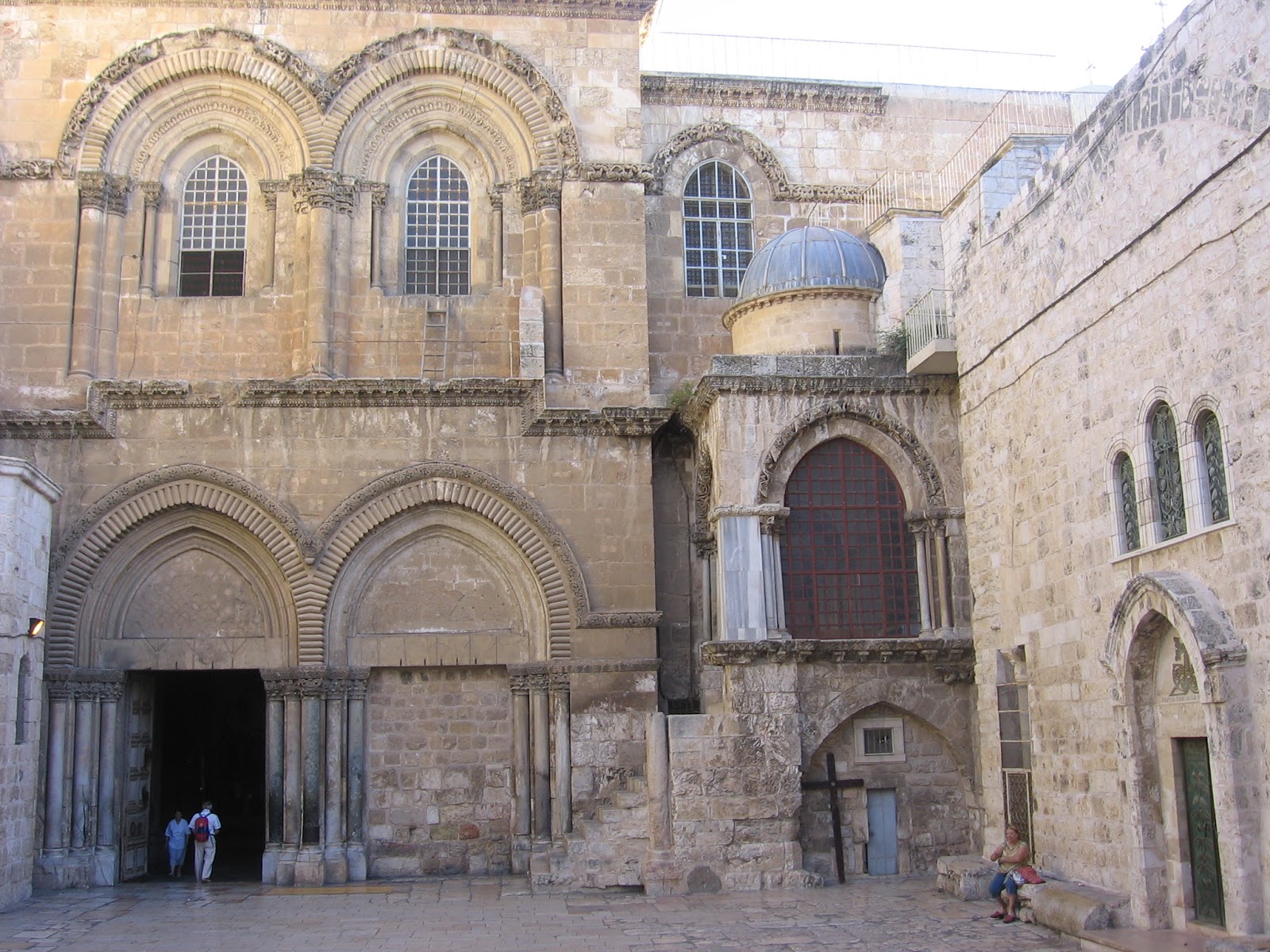
The Church of the Holy Sepulcher
When one goes on pilgrimage, a certain web of grace connects people and places in surprising and unexpected ways.  One of the great surprises of our pilgrimage was in St. Baume, France, at the purported cave of Mary Magdalene.   She is known in the Scriptures as the woman whom Jesus delivered from seven demons, and is also identified as a witness to the death, burial and resurrection of the Lord.  Although she disappears from scriptural tradition after she proclaims the resurrection to the apostles (she is called the Apostle to the Apostles), it is a pious belief that she continued to proclaim the resurrection of Jesus for the rest of her life, even in the face of persecution.  It was even believed that she and her friends were put adrift at sea as a form of execution, and that God saved them and guided them to southern France.   This is how a cave in a remote region of France came to be connected with the initial proclamation of the Gospel. 

Those who climb the mountain at St. Baume find a cave where the Magdalene is said to have lived out a life of quiet penance and contemplation.  A small crypt contains what is believed to be her remains.  Historically, royalty and other government officials came here as an act of penance.  A small plaque indicates Blessed Charles de Foucauld was also drawn to this place as part of his conversion and that intellectuals like the 19th Century Dominican Lacordaire identified this cave as a place of spiritual renewal.  Today, the cave is filled with pilgrims, generally young people, at prayer or at least wanting to pray.  

As for my family and me this summer, we experienced a certain kind of grace that drew us into prayer.  We hiked from the quiet retreat center just below tree-line to the cool dark cave which is just above it.  A certain peaceful silence overtook us as we entered the holy grotto.  Each of us went off by ourselves to be alone in different parts of the cave.  Something in this cave drew us  to prayerful solitude and reflection.

When I came to the reliquary honoring and perhaps containing her remains, I could not help but think of Golgotha and the empty tomb in the Church of the Holy Sepulcher where we had been less than a couple weeks before.  Something about this cave and that empty tomb drew me to contemplate the reality of the resurrection, and the kind of life we want to live when we encounter the Risen Lord.  What if it were true that she who had recognized the Risen Lord had been here?  Would not such a person spend the rest of her life proclaiming the Gospel to the very ends of the earth and praying for the salvation of the world?   After seeing his resurrected eyes gazing on her in love, would she not devote her life to intimacy with him and to making up in her own body what was lacking in his sufferings for the sake of the Church?  If it was not her who had lived in this cave, then it must have been someone like her, for the grace of deep prayer flowed in that cave like the water that dripped from its cracks.  It was the kind of grace which left me wondering whether there might really be something to the highly unlikely but pious scenario connecting St. Baume to Jerusalem.  

The Bells on Mt. Tabor

Some of our pilgrims on Mt. Tabor

I started describing our pilgrimage from this summer – what we did each day from when we left on June 12 until our return on August 3. Unfortunately, memory follows its own chronology and the following event is out of sequence. But of our time in Israel, the memory of one moment is so strong, I need to write about it. In fact, it speaks to a certain aspect of prayer that is often overlooked. Prayer is sometimes greatly helped by symbols – not just signs seen, but also holy things heard and felt, sacred symbols like the music of church bells.  Obviously, a symbol points to something beyond itself, indicating a reality greater than it can contain.  A cross symbolizes Christ’s work of redemption and the conquest of good over evil.  And although symbols are generally thought of in terms of things we see, when it comes to prayer, all creation takes on symbolic proportions, including sound and especially music.  So I plead your patience while I tell you about the bells of Mt. Tabor, which we did not hear on the second day of our pilgrimage but rather on the third.

Mt. Tabor is the place where the transfiguration of Christ Jesus is traditionally believed to have happened. The very large hill overlooks the Valley of Megiddo, a place of biblical, historical and eschatological battles. Jesus ascended this mount with Peter, James and John. As he did this, light and darkness covered the mountain just as happened to both Elijah and Moses in their encounters with God. What is more, Elijah and Moses appeared with Jesus and they spoke together. Peter asked Jesus whether he could build three booths – perhaps a reference to the Feast of Tabernacles – the September feast by which Israel remembers that God had us live in tents when he brought us out of the Land of Egypt, the feast on which Solomon dedicated the Temple – God’s dwelling place, the feast on which pilgrims would journey to the Temple to hear the law, the feast which according to Zechariah the Messiah would make universal for all peoples – the judgment day.   Jesus does not respond to Peter’s request.  There was no need to build another earthly tent.  Jesus himself is a new dwelling for God and Man.  The messianic meaning of tents in the wilderness and the Temple of Solomon were fulfilled in Him.  The whole theophany revealed a great Christian truth about prayer: it is to Christ Jesus we go to know the will of God.  The voice of God came out of the bright cloud surrounding Christ and said, “This is my beloved Son. Listen to Him.”

The Church of the Transfiguration is beautiful and so are the views from atop Mt. Tabor. Yet comes to my memory most vividly was not what I saw but what I heard: the explosion bells just as we began to descend the front of the church. The deep beautiful tones pealing over head physically resonated deep in the heart. Everyone stopped and let the tolling role right through them. It was an incredible moment of prayer.  It was the Angelus. Each resounding toll was a symbol of the voice of God, that voice echoing out to Peter, James and John – His voice that takes away fear and leaves one’s heart in peaceful silence and adoration.

I was reminded of this experience today when I read this from Romano Guardini’s Sacred Signs (Michael Glazier: Wilmington, DE (1979) pp. 89ff.):

“News from afar, news of the infinitely limitless God, news of man’s bottomless desire, and of its inexhaustible fulfillment. The bells are a summons to those “men of desire” whose hearts are open to far-off things. The sound of bells stirs in us the felling of distance. when they clang out from a steeple rising above a wide plain and their sound is carried to every point of the compass, and on and on to the hazy blue horizon, our wishes follow them as long as they are audible, until it comes home t us that there is no satisfaction of desire in far distant hopes, or indeed in anything outside ourselves. Or, when the pealing bells of a mountain-built church flood the valley with their clamor or send the sound straight up to the zenith, the listener, straining to follow, feels his heart expand beyond its usual narrow limits. Or again, the bell tones in some green glimmering forest may reach us faintly, as from a great distance, too far off to tell from where, and old memories stir, and we strive to catch the sounds and to remember what it is they remind us of. At such moments we have a perception of the meaning of space. We feel the pull of the height, and stretch our wings and try to respond to infinitude. The bells remind us of the world’s immensity and man’s still more immeasurable desires m and that only in the infinite God we can find our peace. O Lord, this my soul is wider than the world, its longing from depths deeper than any valley, the pain of desire is more troubling than the faint lost of bell notes. Only thyself canst fill so vast an emptiness.”

The Pilgrimage Continued… still on the first day!

The Copula of the Church of the Annunciation in Nazareth
– built over the place where the Angel Gabriel appeared to Mary

Roman Aquaduct north of Caesarea

Up to the last post, I was sharing about our pilgrimage to the Holy Land.  The first day we set off to Caesarea then Haifa where Mt. Carmel is, then Cana and finally Nazareth.  It was a true whirlwind and when we finally got to our hotel in Tiberius, everyone was exhausted.  Everyone agreed that it was almost too much to take in: the history, the beauty, the culture, and the deep spiritual meaning of each place.  We were submerged in the Scriptures – like a living Gospel, the Holy Land was its own witness to the presence of God in human history and in each of our hearts.

Our group enjoying a view of Haifa
Haifa 

Part of the spirituality of a pilgrimage is learning to be patient with different kinds of hardships.  This particular hardship was disguised.  We were catered to all day, went to some wonderful places of prayer (I will get back to those in the next post), learned a lot from our Arab-Israeli guide – Sami, and ate well.   Before we left, I had explained to everyone that going on a pilgrimage requires a lot of patience.  Now everyone teased me because they felt more spoiled than anything else – they had all expected more spectacular hardships.  At the same time, there was a little sensory overload and, whenever anyone goes into an unfamiliar culture, there are a host of small inconveniences that, even if unnoticed, are a little draining.   So the fatigue was to be expected, and having a little quiet time and personal space welcomed.  No one really complained.

The altar at Cana

There were fourteen of us – mostly friends and family, and some who became friends as we journeyed on our way.  That night, we got together on a terrace overlooking the Sea of Galilee and recounted our favorite adventures.  The experiences were as diverse as the number of pilgrims – so that even if a few mentioned the same place (like the Orthodox Church of Mary’s Well), they recalled it for different reasons. Different kinds of moments of prayer touched us all in different ways – and somethings that did not mean much to one pilgrim were very meaningful to another.  Sharing these helped us all pick up on details we missed and more deeply appreciate the gift God was giving us.   There were also experiences that could not quite be articulated, but that we shared in common nonetheless.

Nazareth

There is an analogy here with praying over the Scriptures.  A whole group of people can have the same Biblical passage read and explained to them, but still have their own experience of what God is speaking to them through the Bible.  That is because the Word of God is inexhaustible: both communal-ecclesial and personal – that is it is addressed to the whole Church and at the same time to each of us in ever new ways.   One of the great blessings of going on a pilgrimage with a group is that we experience this same ecclesial and personal grace through the sacred geography disclosed in Scripture and Tradition.  Such graces have the character of a little exchange of love between God and us, and with one another.

From Caesarea to Carmel

Our pilgrimage continued from Caesarea to Carmel – where there is a Church honoring Elijah in Haifa at the Stella Maris Carmelite Monastery.  Although the monastery only dates from the 19th Century, Carmel has been considered a special place for meeting God even before prophets Elijah and Elisha lived there during their ministries.   For more on this, check out: http://www.newadvent.org/cathen/03352a.htm.

It is at Mt. Carmel where Elijah challenged and defeated the prophets of Ba’al as told in 1 Kings 18:20-46. Inspired by Elijah’s zeal and intimacy with the One true God, a group of crusaders and pilgrims became hermits on the mountain with the blessing of the Patriarch of Jerusalem.  Each hermit lived in a grotto, similar to the one the Church is built over.  These men eventually became known as the Carmelites, a religious community with a special gift for prayer, contemplative prayer in particular.  They were driven out in 1291, but the community never forgot its connection with Carmel even as it spread through Italy, Spain, England and France.  They came back to Carmel in the 19th Century.

Because of their gift for prayer, the Virgin Mary has always been a special patronness of the community.  Our Lady of Mt. Carmel is honored in the Stella Maris church.  In fact, Stella Maris is an ancient title for Mary.  It means “Star of the Sea.”  It is the experience of each of us individually but also of the Church historically that sometimes we struggle to follow the Lord.  This is because the Lord tests our hearts to purify them so that we might see Him face to face.  Mary was given the title Star of the Sea with the conviction that just as sailors look to the stars to find their way, Christians can look to Mary, her Scriptural example and maternal concern for each follower of her Son, to find the Lord.  The monastary in fact looks out over the ocean on  the side of Mt. Carmel.  The Church itself is built over the grotto where Elijah is believed to have lived according to tradition.  

This gift of prayer is also related to Elijah.  After confronting the prophets of Ba’al, Elijah despaired of his life.  But the Lord nourished him and prepared him for a special encounter on another mountain, Mt. Horeb south of Israel.  There, like Moses before him, he experiences a theophany, a manifestation of God’s presence.  Theophanies have a contemplative character, and this is especially true of Elijah’s experience.  This kind of prayer is at the heart of his prophetic mission.  Carmelites seek a similar life of prayer.

“A mighty hurricane split the mountains and shattered Rocks before the Lord.  But the Lord was  not in the hurricane.  And, after the storm, an earthquake.  But the Lord was not in the earthquake.  And after the earthqake, fire.  But the Lord was not in the fire.  And after the fire, a light murmering sound.” (1 Kings 19: 11-13)

Contemplative prayer involves two essential moments – it is first of all a listening for the voice of the Lord, an attending to the slightest murmer of the Lord in our hearts.  Moses and Elijah are connected to one another by this experience and their mission to Israel that flows from it – namely, to help Israel know the Lord.  To achieve this kind of attentiveness to the Lord, a secondary moment is necessary, a moment of struggling for and suffering the truth.   In this moment, every falsehood and fantasy must be put to death.  It is a matter of on going repentance – that is thinking with the mind of God rather than clinging to a merely human perspective.  Ba’alism represents a religion based in fantasy and convenient falsehoods.  It provided a sort of social order by providing a kind of myth that helped everyone relate to one another.  This kind of religion, however, is ultimately degrading.  Human dignity requires the truth.  Only the truth raises the dignity of the human person and makes it possible to hear the voice of God.  In other words, to listen to the voice of the Lord requires a spiritual battle, a fight against evil that can be exhausting.  But in this fight, if we are faithful to the end, the Lord provides us the nourishment we need and blesses us with a special gift of friendship with Him.